When a modern TV develops strange picture problems, many people immediately assume that the screen itself is damaged. However, not every display problem means the panel has failed. A small but important component called the T-CON board can also cause lines, distorted images, flickering, half-screen problems, and other unusual picture issues.
The T-CON, short for Timing Controller, is part of the display signal path. It helps process and coordinate image information between the TV’s main board and the display panel. When it develops a fault, the television may still turn on, produce sound, and respond to the remote while the picture looks completely wrong.
Understanding the symptoms can help you decide whether the TV needs professional diagnosis, a board repair, or potentially a more expensive panel-related solution.
What Is a T-CON Board?
The T-CON board is an electronic circuit board responsible for managing the timing and distribution of video information sent toward the display panel.
In many LCD and LED televisions, the main board processes incoming video content and sends information toward the T-CON. The T-CON then helps convert and organize that information into signals the panel can use to produce the image.
The exact design varies between TV brands and models. Some newer televisions integrate T-CON functions into another board or the display assembly, meaning there may not always be a separate T-CON board that can simply be replaced.
This is one reason why diagnosing a television based only on a symptom can be difficult.
A similar picture problem may originate from:
- The T-CON board
- Ribbon cables
- Main board
- Display panel
- Panel driver circuits
- Power-related circuitry
- External HDMI equipment or cables
Therefore, a technician should confirm the faulty component before ordering a replacement part.
Common Symptoms of T-CON Board Failure
A damaged T-CON board can produce several different display symptoms. Some are more noticeable than others.
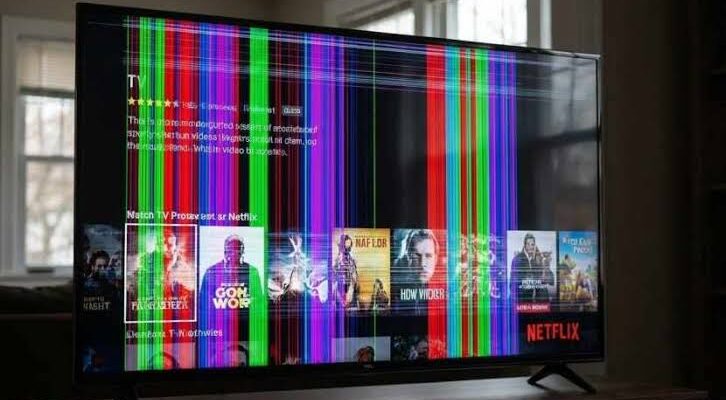
1. Vertical Lines on the Screen
Vertical lines are one of the commonly reported symptoms associated with T-CON or display signal problems.
You may notice:
- Thin vertical lines
- Multiple colored lines
- Vertical bars
- Distorted sections of the picture
- Lines covering a large part of the screen
However, vertical lines do not automatically prove that the T-CON has failed. Ribbon connections, the main board, or the panel itself can produce similar symptoms.
2. Half of the Screen Is Working
Another possible warning sign is a television where one side of the screen looks normal while the other side is black, distorted, unusually bright, or filled with strange patterns.
This can occur when the display signal reaching one section of the panel is interrupted.
The cause could involve the T-CON, ribbon connections, or the panel’s own circuitry. Proper testing is therefore important before deciding on a repair.
3. White, Grey, or Washed-Out Screen
Sometimes a TV turns on normally, the backlight appears to be working, and sound can be heard, but the screen displays a white, grey, or washed-out image.
A T-CON fault can be one possible cause because the backlight and audio can continue working even when the image-processing path has a problem. Other components can create the same symptom, however.
4. Flickering or Unstable Picture
A picture that repeatedly flickers, changes brightness, or appears and disappears can also indicate a problem somewhere in the display signal path.
If the picture is normal when the TV first starts and then becomes distorted after a few minutes, a technician may investigate whether a component is becoming unstable as it warms up.
This symptom alone is not enough to identify the T-CON as the failed component.
5. Incorrect or Inverted Colors
Another possible symptom is unusual color reproduction.
The screen may look:
- Negative or inverted
- Overly bright
- Washed out
- Solarized
- Covered with unusual color patterns
T-CON-related faults can produce these symptoms, but incorrect picture settings, main-board problems, or panel faults should also be considered.
How Can You Tell if the T-CON Is Actually Faulty?
This is where professional diagnosis becomes important.
A useful first test is to check whether the problem appears on the TV’s own menus or startup screen.
For example, if you disconnect your external devices and the TV’s built-in menu still has the same lines or distortion, the problem is more likely to be inside the television rather than an HDMI device.
If the picture problem appears only when using one particular device, consider checking:
- HDMI cable
- Streaming device
- Cable box
- Gaming console
- Input port
- External source settings
iFixit also notes that screen lines can have several possible causes, including connections, cables, T-CON boards, main boards, and the panel.
This is why replacing the T-CON immediately based on a single symptom can sometimes waste money.
Could It Be the Ribbon Cable Instead?
Yes.
Ribbon cables are important connections between the TV’s boards and display panel. If a connection becomes loose, contaminated, damaged, or otherwise unreliable, the television can develop picture problems that look similar to a T-CON failure.
A technician may inspect these connections before replacing a board.
Ribbon cables are delicate, and the connections near the panel can be particularly sensitive. Trying to remove or reseat them without proper knowledge can cause additional damage.
For this reason, opening a large-screen TV should not be treated like replacing a simple computer cable.
T-CON Board vs. Damaged Panel
This distinction matters because the repair economics can be very different.
A defective T-CON board may be replaceable, depending on the television model and availability of the correct part.
A damaged panel is a much more complicated situation. The panel is the actual display assembly and is generally one of the most expensive components of a television.
For example, a TV showing a few fixed lines after physical impact could have a panel or panel-driver problem rather than a T-CON problem. A professional inspection is needed to distinguish between these possibilities.
In some cases, panel-level damage is not economically practical to repair, particularly on older or lower-cost televisions.
What Causes T-CON Board Failure?
There isn’t one single cause.
Potential causes can include:
Electrical Stress
Voltage fluctuations or electrical events can damage sensitive electronic components.
If a TV develops a display fault after an electrical event, the power supply and other boards should also be checked rather than assuming the T-CON is the only affected component.
Component Failure
Electronic components naturally have a finite service life. A board can develop a fault because of a failed IC, capacitor, regulator, or another component.
Heat
Electronic components operate within certain temperature ranges. Excessive heat can contribute to electronic failures or make an existing fault more noticeable.
Physical Damage
Moving a television incorrectly, dropping it, or putting pressure on the display can damage internal connections or the panel itself.
In such cases, a complete inspection is more useful than simply replacing the T-CON.
How Much Does T-CON Board Repair Cost?
There is no single price that applies to every television.
The final repair cost in Saskatoon can depend on several factors, including:
- TV brand
- Exact model number
- Screen size
- Availability of the correct board
- Whether the board can be repaired
- Whether the board must be replaced
- Labour required
- Diagnosis time
- Condition of ribbon cables and connectors
- Whether the panel is also damaged
A simple board-level repair can be very different in cost from replacing an entire board. Likewise, a T-CON issue combined with panel damage may require a completely different repair decision.
Online repair guides show that T-CON replacement prices can vary considerably by model and location, which is why a fixed generic price should not be treated as a reliable quote for a specific television.
For an accurate estimate, the technician generally needs the exact TV model and enough information to identify the faulty component.
Is T-CON Board Repair Worth It?
For many TVs, a confirmed board-level problem is more straightforward to address than a damaged display panel.
But whether repair makes financial sense depends on the television’s age, size, original purchase price, condition, and the total repair estimate.
For example, repairing a relatively recent premium TV may be considered differently from repairing an older television with several existing problems.
If you are considering TV repair in Saskatoon, it is useful to have the exact model number available when requesting a diagnosis. This helps the technician determine whether the TV uses a separate T-CON board and whether replacement parts may be available.
Can You Repair a T-CON Board Yourself?
Basic troubleshooting is reasonable, but opening the TV is a different matter.
You can safely begin with simple checks such as:
- Turn the TV off.
- Disconnect external HDMI devices.
- Restart the television.
- Check whether the TV menu also shows the problem.
- Test another input.
- Inspect external cables for obvious damage.
- Note whether the fault is present immediately after startup.
Avoid opening the television unless you have the appropriate technical experience.
A TV contains electrical components that can present safety risks, while panel ribbons and connectors can be easily damaged. Incorrect handling may turn a repairable board or connection issue into a more expensive problem.
When Should You Contact a Technician?
Professional diagnosis is especially useful when:
- The TV has vertical or horizontal lines across the picture.
- Half the screen is missing or distorted.
- The TV has sound but no usable picture.
- The screen turns white or grey.
- Colors suddenly become abnormal.
- The picture flickers repeatedly.
- The problem remains across multiple inputs.
- The issue appeared after an electrical event.
- The TV has already been reset without improvement.
- The television has suffered physical impact.
A technician can test the signal path and determine whether the T-CON, main board, cable, or panel is actually responsible.
Final Thoughts
A T-CON board failure can create some very confusing television symptoms. Lines, half-screen problems, strange colors, flickering, and a blank or washed-out display can all be associated with the display signal path.
However, these symptoms do not automatically prove that the T-CON board is defective. The same problems can originate from ribbon cables, the main board, panel electronics, or the panel itself.
That is why diagnosis should come before purchasing a replacement board.
For homeowners dealing with persistent display problems, TV repair services in Saskatoon can provide a way to have the television properly assessed before deciding whether repair or replacement makes more sense.
The most important thing is to identify the actual failed component. A correct diagnosis can prevent unnecessary parts replacement and give you a clearer idea of the expected repair cost.